Quick Answer
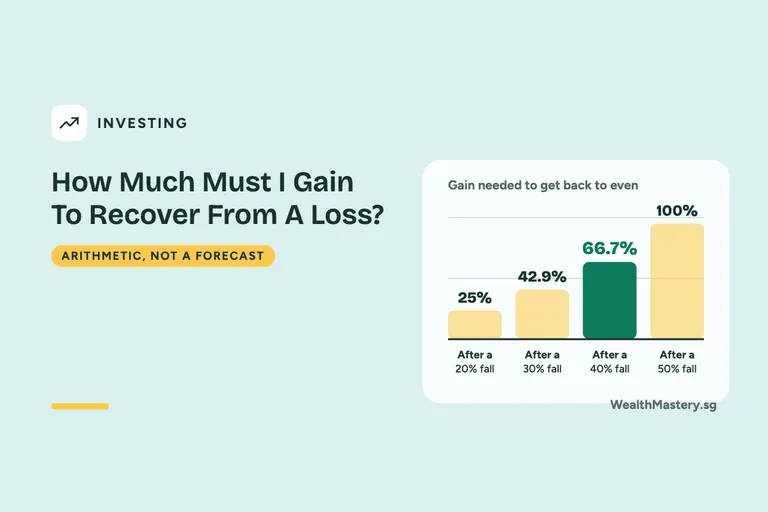
The gain needed is always bigger than the loss, because it is worked out on a smaller amount. A 40% fall needs a 67% gain to get back to where you started. At a steady 7% a year, that would take about 7.6 years, and a 100% loss cannot be recovered.
The Useful Number: A 40% fall needs a 67% gain to break even. At a steady 7% a year, that takes about 7.6 years.
Why Is The Gain Bigger Than The Loss?
A gain is worked out on what is left after the fall. If S$10,000 falls 40%, you have S$6,000. After a 50% fall it would be S$5,000, which must double. To get back to S$10,000, S$6,000 must grow by S$4,000, which is 67% of S$6,000.
The formula is gain needed = 1 ÷ (1 − loss) − 1. The bigger the fall, the faster the gain needed climbs, and a 100% loss cannot be recovered at all.
How Long Could Recovery Take At 7% A Year?
- 20% fall: 25% gain, about 3.3 years
- 30% fall: 42.9% gain, about 5.3 years
- 40% fall: 66.7% gain, about 7.6 years
- 50% fall: 100% gain, about 10.2 years
These years assume a steady 7% every year from the lower value, which real markets never deliver. Recoveries can be much faster or much slower, and some holdings never recover.
- Start: S$10,000
- After A 40% Fall: S$6,000
- Gain Needed: S$4,000 On S$6,000: 67%
- Back To: S$10,000
Data as of . Source: MoneySense — Investment Risk.
What Does This Leave Out?
It ignores new money you add, withdrawals, dividends, fees and tax. Adding money after a fall changes your own recovery, which the compound growth calculator can model.
What Can You Take From This?
Big falls are hard to climb back from, which is one reason people spread risk and keep cash they need soon out of shares. Check your buffer with the emergency fund guide. This guide does not recommend any investment.
Quick Check
Three statements from this guide. Tap True or False to check what you have read. Nothing is saved.
Card 1 Of 3
A 40% fall needs a 40% gain to get back to where you started.
Why?
S$10,000 falls to S$6,000, and S$6,000 must grow by S$4,000.
Card 2 Of 3
A 50% fall needs a 100% gain to recover.
Why?
At a steady 7% a year that would take about 10.2 years.
Card 3 Of 3
The recovery years are a forecast of how markets will behave.
Why?
Recoveries can be much faster or much slower, and some holdings never recover.
Your Score
Try It With Your Numbers
Open the calculator with this guide’s example filled in. Then change the numbers to match your situation.
Open Loss Recovery Calculator →Frequently Asked Questions
Why Does A 50% Fall Need A 100% Gain?
After a 50% fall, S$10,000 becomes S$5,000.
To reach S$10,000 again, the S$5,000 has to double, which is a 100% gain.
Is The Recovery Time A Forecast?
No.
It assumes a steady return every year from the lower value. Real markets rise and fall unevenly, and some holdings never recover.
Does Adding Money Change My Recovery?
Yes.
New money added after a fall changes your own recovery, but the calculator leaves it out. Use the compound growth calculator to model regular additions.
Try Loss Recovery Calculator →Save Guides Free
Keep This Guide For Your Next Money Decision.
Build your own reading list and pick up where you left off with a free WealthMastery account.
Free account · Tools stay free without an account.
Sources & Assumptions
Sources checked 12 October 2026. These are examples only. Check the stated assumptions and limits before you use a result.
General information and estimates, not advice. Recovery years assume a steady yearly return, which real markets do not deliver. Checked 4 October 2026.