Quick Answer
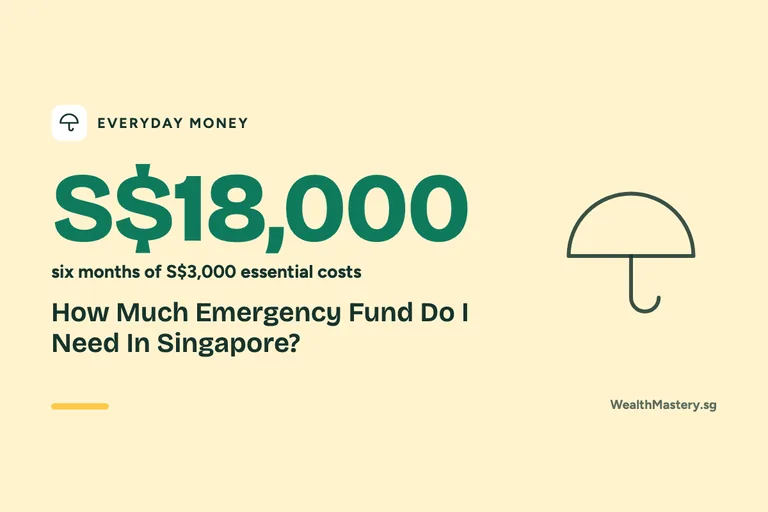
MoneySense gives three to six months of expenses as a starting point. Your target depends on how steady your income is, who depends on you and how long replacing income might take. A six-month target would be S$18,000, leaving S$9,000 still to save.
The Useful Number: S$9,000 covers three months of S$3,000 essential spending. A six-month target would be S$18,000.
How Do You Work Out Your Costs And Target?
An emergency fund is cash for shocks, like lost income or an urgent essential cost. List what you would still pay if your income stopped: housing, groceries, utilities, transport, insurance and minimum debt payments.
MoneySense gives three to six months of expenses as a starting point. Your target depends on how steady your income is, who depends on you and how long replacing lost income might take.
What Does A Six-Month Buffer Look Like?
Say essential spending is S$3,000 a month and you have S$9,000 of emergency cash. That covers 3 months. A six-month target is S$18,000, so S$9,000 is still needed: about 9 months at S$1,000 a month.
That assumes no withdrawals and the same amount saved each month, with interest and inflation left out. If saving that much leaves you short for current bills, change the amount or the target.
- Today: S$9,000 Saved: Covers 3 months (S$9,000 ÷ S$3,000).
- Add S$1,000 Each Month: S$9,000 still needed, so about 9 months.
- Target: S$18,000: Six months of essential spending (S$3,000 × 6).
Sources checked . Source: MoneySense — managing your money.
Try Your Numbers
How Long Would Your Cash Last?
Your Cash Covers
3 months
- Target Emergency Fund
- S$18,000
- Time To Reach The Target
- 9 months
Rough estimate. See the full tool for assumptions.
What Money Should Count Towards Your Emergency Fund?
Do not count the same savings as both a house deposit and an emergency fund. Leave credit limits, CPF and investments out. They have different rules on when you can use them, or you may have to borrow or sell at a bad time.
Before choosing where to keep it, check how fast you can get the money, the withdrawal conditions and any charges. A high advertised return does not mean the money will be there when an urgent bill arrives.
How Do You Keep Your Buffer Up To Date?
Recalculate after a move, a new dependant, a change in income or using the buffer. Budget for predictable costs, such as a yearly renewal, separately. The Monthly Savings Split helps you find a monthly amount that fits.
Quick Check
Three statements from this guide. Tap True or False to check what you have read. Nothing is saved.
Card 1 Of 3
MoneySense gives three to six months of expenses as a starting point.
Why? Card 1 Of 3
Your own target depends on how steady your income is, who depends on you and how long replacing lost income might take.
Card 2 Of 3
CPF savings and investments should count towards your emergency cash.
Why? Card 2 Of 3
You may not be able to reach CPF, and you may have to sell investments at a bad time. Leave them, and credit limits, out of the cash figure.
Card 3 Of 3
With S$9,000 still to save, putting aside S$1,000 a month takes about nine months.
Why? Card 3 Of 3
The estimate assumes the same amount every month and no withdrawals. It leaves out interest and inflation, so do not treat the date as fixed.
Your Score
Try It With Your Numbers
Open the calculator with this guide’s example filled in. Then change the numbers to match your situation.
Open Emergency Fund Calculator →Frequently Asked Questions
What Expenses Should An Emergency Fund Cover?
List the spending you would still need to cover if your income stopped.
Include housing, groceries, utilities, basic transport, insurance and minimum debt payments. Keep predictable costs, such as a yearly renewal, apart from unexpected ones. Budget for them over the year.
How Long Will It Take To Build My Emergency Fund?
In the worked example, you still need S$9,000 to reach an S$18,000 six-month target.
At S$1,000 saved each month, that takes nine months. This assumes no withdrawals and the same amount each month. Interest and inflation are left out. If saving that much leaves you short for current bills, change the amount or the target.
Should CPF Or Investments Count Towards My Emergency Fund?
The calculator leaves credit limits, CPF and investments out of the cash figure.
Those have different rules on when you can use them, or you may have to borrow or sell at a bad time. The guide also warns against counting the same savings as both a house deposit and an emergency fund.
Try Emergency Fund Calculator →Where Should I Keep My Emergency Fund?
The guide does not recommend any account or product.
Before choosing where to keep the buffer, check how fast you can get the money, the withdrawal conditions and any charges. A high advertised return does not tell you whether the money will be there when an urgent bill arrives.
Get The Checklist (Free For Members)
Build Your Emergency Fund And Budget. Simple steps to set up a budget and a safety cushion you can reach fast.
Get The ChecklistFree account. No password needed.
Save Guides Free
Keep This Guide For Your Next Money Decision
Build your own reading list and pick up where you left off with a free WealthMastery account.
Free account · Tools stay free without an account.
Sources & Assumptions
Sources checked 11 September 2026. These are examples only. Check the stated assumptions and limits before you use a result.
Planning example using the costs, cash and target you enter. It leaves out interest, inflation and withdrawals. It does not recommend any account or product.