Quick Answer
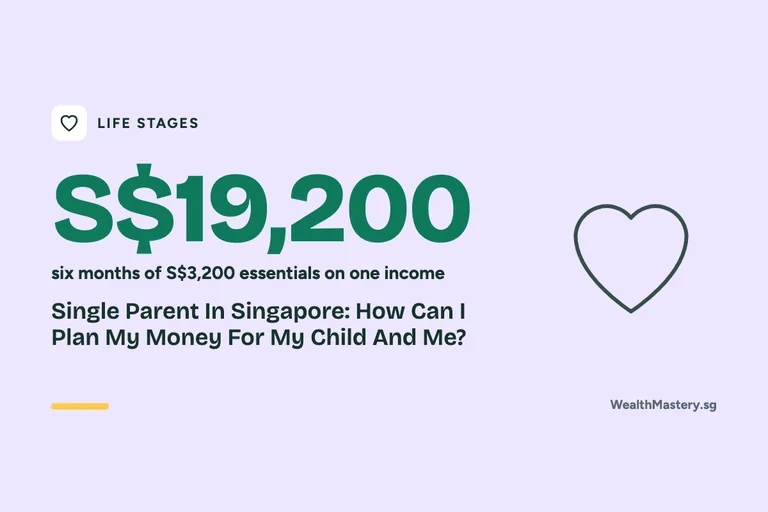
Protect the one income your child relies on first. Aim for six months of essentials: S$3,200 a month makes S$19,200. Then check your cover, name a guardian in your will and make a CPF nomination. After that, look at school help, tax reliefs, HDB options and maintenance.
The Useful Number: On one income, aim for the top of the usual three-to-six-month range. S$3,200 of monthly essentials makes a six-month buffer of S$19,200.
Where Should You Start?
Whether you are divorced, separated, widowed or never married, the plan is the same: protect the one income your child relies on, then build from there. This guide takes the steps in that order. Some schemes depend on your marital status, and each section says so where it matters.
Every step links to a free calculator or an official page. None of it needs you to share your details with us.
How Big Should Your Emergency Fund Be On One Income?
MoneySense suggests setting aside at least three to six months of expenses. With one income and no second earner to fall back on, aim for the top of that range. List what you would still pay if your pay stopped: housing, food, utilities, transport, school costs, insurance and minimum debt payments.
Say your essentials come to S$3,200 a month. Six months is S$19,200. That can feel far away on one income, so save in milestones. With S$1,600 saved (0.5 months of essentials) and S$400 a month put aside, your first milestone is one month of expenses (S$3,200), reached in 4 months. Three months (S$9,600) follows 16 months after that, 20 months from now. From one month, the last S$16,000 to the full six months takes another 40 months, about 44 months in all, if nothing is withdrawn. Any amount helps: each pay rise or bill that ends brings the next milestone sooner. If you receive maintenance, build the buffer as if a payment could be late.
- Saved So Far: S$1,600
- Still To Save For One Month: S$1,600
- Then To Save For Six Months: S$16,000
- Six-Month Target: S$19,200
Data as of . Source: MoneySense — Basic Financial Planning Guide.
Try Your Numbers
Your Buffer On One Income
Target Emergency Fund
S$19,200
- Your Cash Covers
- 0.5 months
- Time To Reach The Target
- 44 months
Rough estimate. See the full tool for assumptions.
What Insurance Does A Sole Earner Need?
If your income stopped, your child would lose their main support. MoneySense’s rules of thumb are death and total permanent disability (TPD) cover of about 9 times your yearly income, critical illness cover of about 4 times, and spending no more than 15% of your income on protection. These are starting points, not a quote or a recommendation.
The Coverage Gap calculator adds up what your child would need, then subtracts savings and cover you already have. For each policy, check who the nominee is. A trust nomination can be made for your spouse or children only, and the policy money then stays outside your estate.
Who Would Look After Your Child?
Under the Guardianship of Infants Act, a mother or father can appoint a guardian for their child by deed or will, to act after their death. If your child’s other parent is alive, the guardian acts jointly with them, and the court decides if they disagree. Talk to a lawyer about your situation, especially if you share custody.
Your will does not cover your CPF savings. They follow your CPF nomination, and without one the Public Trustee’s Office distributes them under the law, not your wishes. The Legacy Checklist shows which steps you still need.
What Help Is There For School Costs?
Every Singapore Citizen child has an Edusave account. In 2026 it receives S$230 a year in primary school and S$290 a year in secondary school, for approved school fees and programmes.
From 2026, MOE’s Financial Assistance Scheme (FAS) covers households with a gross monthly income of S$4,000 or less, or S$1,000 or less per person. The Edusave Merit Bursary, for students who do well, has a higher limit: S$9,000 or less, or S$2,250 or less per person. Schools also have their own help for families just outside the schemes, so ask the school.
For younger children, the Child Development Account (CDA) gives a first child a S$5,000 First Step Grant, and the Government matches your savings up to S$4,000. Under the SG Child Support Package (2026 National Day Rally), a child born from 1 January 2015 keeps the CDA until the end of the year they turn 16 (start date to be confirmed), and all caps become S$5,000 from 1 October 2027. Children of parents who have never married get these CDA benefits if born on or after 1 September 2016. The Baby Bonus Cash Gift is only for married parents. For preschool, the Additional Subsidy needs the main applicant, the mother or a single father, to be working, with household income of S$12,000 or less (S$15,000 from 2027). The Kids’ Education calculator turns school costs into a monthly amount.
Which Tax Reliefs Can You Claim?
For income earned in 2025 (Year of Assessment 2026), Qualifying Child Relief (QCR) is S$4,000 per child, or Child Relief (Disability) of S$7,500 for a child with a disability. You can share it with your ex-spouse by agreement, but the total for each child stays the same.
Working Mother’s Child Relief (WMCR) is for working mothers who are married, divorced or widowed; IRAS says single taxpayers are not eligible. For a child born before 2024, it is 15% of your earned income for your first child. For a child born or adopted from 1 January 2024, it is a fixed S$8,000 for a first child. QCR and WMCR together are capped at S$50,000 per child.
Example: a divorced mother earning S$62,400 in 2025, with one child born in 2012, could claim QCR of S$4,000 and WMCR of S$9,360. If you have never married, ask IRAS which reliefs apply to you. Try the Tax Relief Finder.
What Are Your Housing Options?
If you are divorced or widowed, you can buy an HDB flat with the children under your legal custody, care and control. If care and control is shared, you need your ex-spouse’s written agreement to list your child. If you have never married, write to HDB about buying a flat with your child; HDB assesses each case as a whole.
Divorced and widowed parents who have had an HDB housing subsidy before (second-timers) can apply under ASSIST, which sets aside some 2-room Flexi and 3-room flats in Standard projects in each BTO exercise. You need at least one child aged 18 or below. If you have booked a new flat that is still being built, the Parenthood Provisional Housing Scheme lets eligible divorced or widowed parents rent a flat from HDB while they wait. Apply for an HDB Flat Eligibility (HFE) letter before you commit to any flat.
How Do Child Maintenance And Enforcement Work?
If your child’s other parent neglects or refuses to pay reasonable maintenance, you can apply to the Family Justice Courts for a maintenance order. If an order is not paid, you can apply to enforce it. From 1 July 2026, every enforcement application goes through the Maintenance Enforcement Process: officers from the Ministry of Law work with both sides and can ask banks and public agencies for financial information.
For your budget, count maintenance only once it arrives reliably. Use the official Family Justice Courts maintenance page to start.
Where Can You Get Help?
Family Service Centres offer counselling, casework and practical support; find one near you on MSF’s directory. ComCare helps families who need help with daily living costs, and SupportGoWhere lists the schemes you may qualify for. For divorce and family matters, MSF’s Family Assist line is 1800-111-2222 (say “Family Assist”). Asking for help is a normal part of a good plan.
What Should You Do This Month?
- Add up your monthly essentials and set a six-month buffer target.
- List your policies, what each pays for and who the nominee is.
- Make or update your will, name a guardian and check your CPF nomination.
- Check your child’s Edusave and any school or MOE help you may qualify for.
- Note the tax reliefs to claim when you next file.
Quick Check
Three statements from this guide. Tap True or False to check what you have read. Nothing is saved.
Card 1 Of 3
On S$3,200 of monthly essentials, a six-month buffer is S$19,200.
Why?
MoneySense suggests three to six months of expenses. With one income, the top of the range gives your child more time if your pay stops.
Card 2 Of 3
A mother who has never married can claim Working Mother’s Child Relief.
Why?
Qualifying Child Relief has its own conditions. If you have never married, ask IRAS which reliefs apply to you.
Card 3 Of 3
Children of parents who have never married can get CDA benefits.
Why?
The Baby Bonus Cash Gift is different: it is only for lawfully married parents.
Your Score
Start With Your Safety Net
Open the emergency fund calculator with this guide’s example, then change the numbers to your own. Your figures stay on your device.
Size My Buffer → Check My Cover Gap → Sort My Will And Nominations →Frequently Asked Questions
How Much Emergency Fund Does A Single Parent Need?
MoneySense suggests at least three to six months of expenses.
With one income, aim for six. If your essentials are S$3,200 a month, that is S$19,200. Count maintenance only once it arrives reliably.
Can A Single Mother Claim Working Mother’s Child Relief?
Only if she is married, divorced or widowed.
IRAS says single taxpayers are not eligible for WMCR. For a child born before 2024 it is 15% of earned income for a first child; for a child born or adopted from 1 January 2024 it is S$8,000. QCR of S$4,000 per child has separate conditions.
Do Children Of Unmarried Parents Get Baby Bonus Or CDA Money?
The Baby Bonus Cash Gift is only for lawfully married parents.
Singapore Citizen children born on or after 1 September 2016 to parents who have never married can get CDA benefits: the First Step Grant and Government co-matching up to the cap.
Can A Divorced Parent Buy An HDB Flat With Their Child?
Yes, a divorced or widowed Singapore Citizen can apply with children under their legal custody, care and control.
Shared care and control needs the ex-spouse’s written agreement. Never-married parents should write to HDB, which assesses each case. Get an HDB Flat Eligibility letter first.
What Can I Do If Maintenance Is Not Paid?
Apply to the Family Justice Courts to enforce the maintenance order.
From 1 July 2026, every enforcement application goes through the Maintenance Enforcement Process, where officers can ask banks and public agencies for financial information. Start from the official Family Justice Courts maintenance page.
Get The Checklist (Free For Members)
Protect Your Family Money Checklist. Fifteen steps to protect the income your child relies on, from a bigger buffer to a named guardian, school help and tax reliefs.
Get The ChecklistFree account. No password needed.
Save Guides Free
Keep This Guide For Your Next Money Decision.
Build your own reading list and pick up where you left off with a free WealthMastery account.
Free account · Tools stay free without an account.
Sources & Assumptions
- MoneySense — Basic Financial Planning Guide ↗
- IRAS — Working Mother’s Child Relief ↗
- IRAS — Qualifying Child Relief And Child Relief (Disability) ↗
- MOE — Edusave Account ↗
- MOE — Financial Assistance Income Criteria From 2026 ↗
- LifeSG (MSF) — Baby Bonus Eligibility ↗
- LifeSG (MSF) — Child Development Account ↗
- LifeSG (MSF) — SG Child Support Package ↗
- ECDA — Infant And Childcare Subsidies ↗
- HDB — Couples And Families Eligibility ↗
- HDB — Priority Schemes (ASSIST) ↗
- HDB — Parenthood Provisional Housing Scheme ↗
- Family Justice Courts — Maintenance Orders ↗
- Ministry of Law — Maintenance Enforcement Process ↗
- Singapore Statutes Online — Guardianship of Infants Act 1934 ↗
- CPF Board — Making A CPF Nomination ↗
- Singapore Statutes Online — Insurance Act 1966, Part 3C ↗
- MSF — Family Service Centres Directory ↗
- MSF — ComCare ↗
- MSF Family Assist — Contact Us ↗
Sources checked 6 October 2026. These are examples only. Check the stated assumptions and limits before you use a result.
General information, not financial, tax or legal advice. Rules and figures checked on 6 October 2026 against the official sources listed, and they can change. Each agency decides who qualifies. The buffer and tax examples are simplified illustrations: the tax example assumes the mother claims QCR herself and has no other child reliefs.