Quick Answer
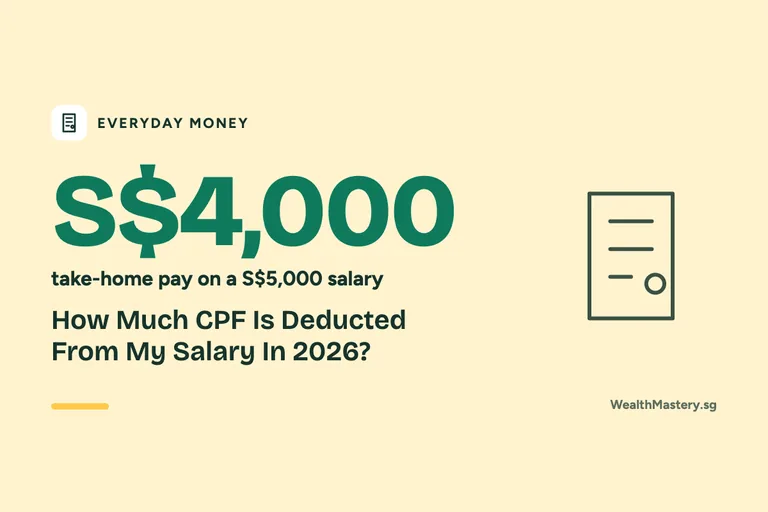
In this 2026 example, a 35-year-old Singapore Citizen earns S$5,000 a month in Ordinary Wages. Employee CPF at 20% takes S$1,000, leaving S$4,000 before income tax and other deductions. Your employer adds S$850 on top. That goes to your CPF accounts, not your bank.
The Useful Number: A S$5,000 monthly salary leaves S$4,000 after employee CPF in this example, before income tax and other deductions.
How Much Actually Reaches Your Bank?
Your payslip can show three numbers. Gross salary is your pay before deductions. Employee CPF comes out of it. Employer CPF is paid on top, into your CPF accounts.
Budget from the cash that reaches your bank. Then set money aside for income tax and other bills not already deducted. The calculator estimates the CPF part only, not your full payslip.
- Your Monthly Wage
- You Contribute: 20%
- Employer Adds: 17%
- Total Into CPF: 37%
- Ordinary Account: 23%
- Special Account: 6%
- MediSave Account: 8%
Data as of . Source: CPF Board — contribution and allocation rates.
How Much CPF Comes Off A S$5,000 Salary?
Take a 35-year-old Singapore Citizen, or a Permanent Resident in the third year onward, earning S$5,000 a month in Ordinary Wages (regular monthly pay). For this example, the 2026 employee rate is 20% and the employer rate is 17%.
So S$1,000 of employee CPF comes off, leaving S$4,000. Your employer adds S$850, bringing total monthly CPF to S$1,850. None of that S$850 reaches your bank.
- Cash To Your Bank: S$4,000
- Employee CPF (20%): S$1,000
- Employer CPF (17%): S$850
- Total Monthly Package: S$5,850
Data as of . Source: CPF Board — contribution and allocation rates.
Try Your Numbers
Your Pay After Employee CPF
Cash After Employee CPF
S$4,000/mth
- Employee CPF Deducted
- S$1,000
- Employer CPF, Paid Separately
- S$850
Rough estimate. See the full tool for assumptions.
When Will Your CPF Deduction Be Different?
CPF rates change with age and Permanent Resident status, and lower monthly wages have different rules. The calculator covers full-rate contributions for monthly wages above S$750. Bonuses and other Additional Wages are treated separately and left out, so do not apply this percentage to every payment.
If your case is different, use the official CPF contribution calculator and compare it with your payslip.
How Do You Turn Take-Home Pay Into A Monthly Plan?
Check the amount paid in against your payslip, set aside money for income tax if needed, and enter what is left into the Monthly Savings Split. Keep yearly bills, such as an insurance renewal, in that budget.
Comparing two job offers? Calculate one salary, tap Keep This Scenario, then calculate the other.
Quick Check
Three statements from this guide. Tap True or False to check what you have read. Nothing is saved.
Card 1 Of 3
Employer CPF is added to the cash paid into your bank each month.
Why?
In the S$5,000 example your employer pays S$850 on top of your salary. It raises total monthly CPF to S$1,850 but does not add to the cash you can spend.
Card 2 Of 3
At age 35, employee CPF on a S$5,000 monthly salary is S$1,000 in 2026.
Why?
This is for a Singapore Citizen, or a Permanent Resident in the third year onward, earning S$5,000 in Ordinary Wages. It leaves S$4,000 before income tax and other deductions.
Card 3 Of 3
You can apply the same CPF percentage to your bonus.
Why?
The calculator covers monthly Ordinary Wages above S$750 and leaves Additional Wages out. Check a bonus with the official CPF contribution calculator.
Your Score
Try It With Your Numbers
Open the calculator with this guide’s example filled in. Then change the numbers to match your situation.
Open Salary After CPF Calculator →Frequently Asked Questions
Does Employer CPF Add To My Take-Home Pay?
No.
In the worked example, your employer pays S$850 into your CPF accounts separately. That makes total monthly CPF S$1,850. But it does not add to the cash you can spend this month. Budget from the amount that actually reaches your bank.
Why Might My CPF Deduction Differ From This Example?
CPF rates change with age and Permanent Resident status.
Lower monthly wages have different rules. Bonuses and other Additional Wages are treated separately. The calculator covers full-rate contributions for monthly wages above S$750 and leaves out Additional Wages. If your case is different, use the official CPF contribution calculator and compare it with your payslip.
Try Salary After CPF Calculator →Is My Salary After CPF The Same As My Budget?
Not always.
You still need to allow for income tax and any other bills not already deducted. Check the amount paid in against your payslip. Set aside money for income tax if needed. Then enter what is left into the Monthly Savings Split. Keep yearly bills, such as an insurance renewal, in mind.
Try Monthly Savings Split →Can I Apply The Same CPF Percentage To My Bonus?
Do not apply this example’s percentage to every payment you receive.
Bonuses and other Additional Wages are treated separately, and this calculator leaves them out. Confirm the required contribution with CPF Board or the official CPF contribution calculator.
Try Salary After CPF Calculator →Get The Checklist (Free For Members)
Your First Job Money Checklist. What to check and set up from your first payslip to your first tax return.
Get The ChecklistFree account. No password needed.
Save Guides Free
Keep This Guide For Your Next Money Decision.
Build your own reading list and pick up where you left off with a free WealthMastery account.
Free account · Tools stay free without an account.
Sources & Assumptions
Sources checked 12 October 2026. These are examples only. Check the stated assumptions and limits before you use a result.
Example for the stated age, wages and CPF status only. It leaves out income tax, bonuses and other payroll deductions. Confirm the required contribution with CPF Board.