Quick Answer
There is no single answer. It depends on eligibility, returns, future tax and when you need the money. With the example assumptions, an S$8,000 eligible contribution saves S$920 in current tax through either CPF or SRS. SRS ends highest under those assumptions. But access and future tax still matter, and other inputs can change the result.
The Useful Number: With the example assumptions, an S$8,000 eligible contribution saves S$920 in current tax; access and future tax still matter.
How Do You Compare One Amount Across Three Routes?
The tool compares the same amount put into an eligible CPF cash top-up, the Supplementary Retirement Scheme (SRS) or direct investing. For CPF and SRS, it assumes the tax you save now is reinvested.
Enter your chargeable income after other reliefs and the personal relief you can still claim under the cap. Check that the top-up itself qualifies: room under the cap does not make a non-qualifying contribution deductible.
How Does An S$8,000 Decision Work Out?
The example uses S$100,000 chargeable income, S$8,000 to put in, S$8,000 of relief room, 20 years, 4% CPF growth, 5% investment growth and 7% tax on the taxable half of the SRS withdrawal.
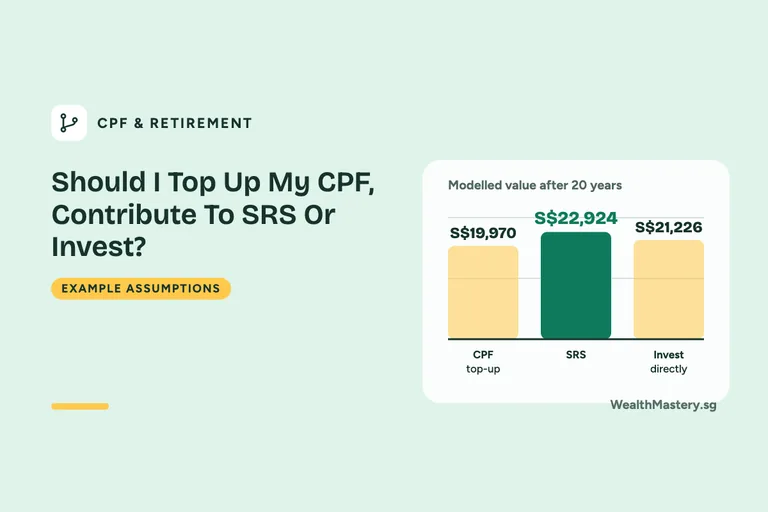
CPF and SRS each save S$920 in tax now. The modelled values are S$19,970 for CPF, S$22,924 for SRS and S$21,226 for investing directly, so SRS ends highest. That is not a recommendation: a different return, tax rate or eligibility outcome, or needing the money sooner, can change the answer.
- S$8,000 Put In Once
- CPF Top-Up: Tax Saved: S$920
- SRS: Tax Saved: S$920
- Invest: Tax Saved: S$0
- CPF After 20 Years: S$19,970
- SRS After 20 Years: S$22,924
- Invest After 20 Years: S$21,226
Data as of . Source: IRAS and CPF Board — CPF cash top-up relief; IRAS — SRS contributions and tax relief.
Which Relief And Withdrawal Conditions Should You Check?
IRAS allows relief for qualifying CPF cash top-ups within set limits. The comparison uses the S$8,000 self top-up relief and the citizen/PR SRS limit of S$15,300, both capped by the relief room you enter.
Under the 50% SRS withdrawal tax concession, only half of a qualifying retirement withdrawal is taxed, from the statutory retirement age in force when you first contributed. The tool assumes it applies, and does not check your age, copy a withdrawal schedule or work out early (premature) withdrawal penalties.
When Will You Need The Money?
A projected account value is not always cash you can take out. CPF top-ups and SRS have withdrawal rules, so keep money for near-term needs and emergencies apart.
Use the Tax Relief Finder guide to check the inputs behind a tax saving, then check account rules and your limits before moving money. The 4% and 5% growth rates are steady example inputs.
Quick Check
Three statements from this guide. Tap True or False to check what you have read. Nothing is saved.
Card 1 Of 3
If you have S$8,000 of relief room left, any CPF top-up you make is deductible.
Why?
Room under the overall cap does not make a contribution that does not qualify deductible. Check that the top-up qualifies before you count on the tax saving.
Card 2 Of 3
In the example, CPF and SRS both save S$920 in tax now.
Why?
Under the example assumptions, the modelled values after 20 years are S$19,970 for CPF, S$22,924 for SRS and S$21,226 for direct investing. That is not a recommendation.
Card 3 Of 3
The tool checks your age before applying the 50% SRS withdrawal tax concession.
Why?
Only half of a qualifying SRS withdrawal is taxed. The tool does not check your age, copy a withdrawal schedule or work out penalties for early withdrawal.
Read: Which Relief And Withdrawal Conditions Should You Check?
Your Score
Try It With Your Numbers
Open the calculator with this guide’s example filled in. Then change the numbers to match your situation.
Open CPF Top-Up Vs SRS Vs Invest →Frequently Asked Questions
Which Route Ends With The Most Money In The Example?
Take S$100,000 chargeable income, S$8,000 put in, 20 years, 4% CPF growth, 5% investment growth and a 7% tax rate on the taxable half of the SRS withdrawal.
The modelled values are S$19,970 for CPF, S$22,924 for SRS and S$21,226 for direct investing. That is not a recommendation.
What Relief Limits Does The Comparison Use?
It uses a maximum S$8,000 self top-up relief for qualifying CPF cash top-ups.
It uses the citizen/PR SRS contribution limit of S$15,300. Both routes are also limited by the personal-relief room you enter. Room under the overall cap does not make a contribution that does not qualify deductible.
Is The Projected Value Money I Can Withdraw?
Not always.
A projected account value is not always cash you can take out at the end of the period. CPF top-ups and SRS have rules on when you can withdraw. Keep money for near-term needs and emergencies apart from a long-term contribution.
Does The Tool Model SRS Withdrawal Tax?
It assumes the 50% SRS withdrawal tax concession applies to qualifying withdrawals.
It does not check your age, copy a withdrawal schedule or work out penalties for early (premature) withdrawal. Check the IRAS rules on SRS withdrawals for your own situation.
Get The Checklist (Free For Members)
Year-End Tax, SRS And CPF Top-Up Checklist. What to do by 31 Dec 2026 to cut your YA 2027 tax bill.
Get The ChecklistFree account. No password needed.
Save Guides Free
Keep This Guide For Your Next Money Decision.
Build your own reading list and pick up where you left off with a free WealthMastery account.
Free account · Tools stay free without an account.
Sources & Assumptions
- IRAS — CPF Cash Top-Up Relief ↗
- IRAS — SRS Contributions And Tax Relief ↗
- IRAS — Tax On SRS Withdrawals ↗
Sources checked 12 October 2026. These are examples only. Check the stated assumptions and limits before you use a result.
Simplified comparison. It assumes tax savings are reinvested and growth stays constant. It does not confirm eligibility, access, future rates or the best way to withdraw. Fees and policy changes are left out.