Quick Answer
Split your cash into equal rungs that start one after another, so one rung matures each time you choose. In the example, S$60,000 in six 6-month T-bills frees up S$10,000 every month once built, with about S$1,149 interest a year at a 1.92% yield. Each rung is a new auction application.
The Useful Number: In the example, S$60,000 in six 6-month T-bills frees up S$10,000 every month once the ladder is built, with about S$1,149 interest a year at a 1.92% yield.
What Is A Ladder, And Why Build One?
A ladder splits one sum into equal rungs: T-bills or fixed deposits that start, and so mature, at different times. Once built, part of your money returns on a regular schedule while the rest keeps earning.
It suits money you need soon but not all at once, such as renovation, school fees or a retiree’s next year of spending. Keep your emergency fund where you can reach it the same day.
What Does S$60,000 In Monthly Rungs Look Like?
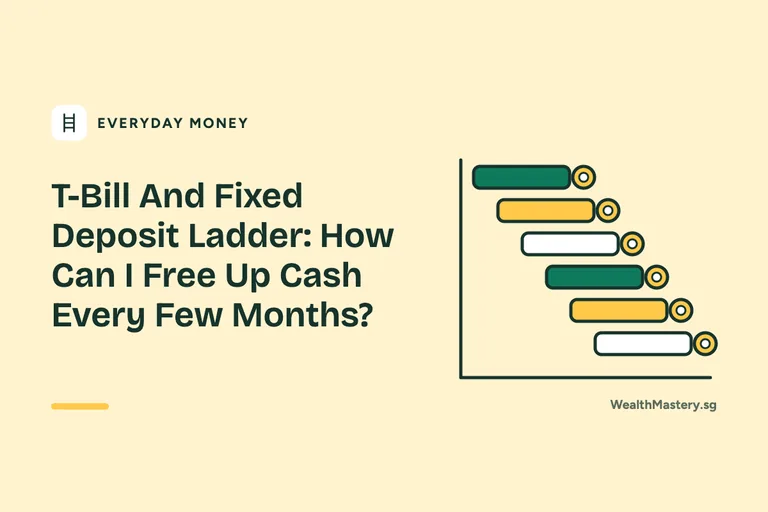
Say you want money back every month from 6-month T-bills. Six months ÷ one month = six rungs of S$10,000: apply for one bill a month for six months, and from month 6 one matures every month. Each rung earns about S$96 at 1.92% for 182 days, about S$1,149 a year once all six run.
The 1.92% is the 24 September 2026 cut-off yield, a past result, not an offer. Yields change at every auction.
- Now: Apply For Rung 1: S$10,000 in a 6-month T-bill at the next auction.
- Months 1 To 5: Add Rungs 2 To 6: One new S$10,000 bill each month until all six are running.
- Month 6: Rung 1 Matures: Its S$10,000 face value comes back, including about S$96 interest. Apply again to keep it going.
- Then: S$10,000 Every Month: About S$1,149 interest a year at a 1.92% yield, a past result, not an offer.
Sources checked . Source: MAS — auctions and issuance calendar.
Try Your Numbers
Your T-Bill Ladder Interest
Uses six 6-month T-bills with money back every month, as in the example, each reinvested at the same yield with no waiting time.
Interest A Year Once Built
S$1,149
- Back Every Month From Month 6
- S$10,000
- Interest Per Rung
- S$96
Rough estimate. See the full tool for assumptions.
Why Is Every Rung A New Application?
MAS auctions 6-month T-bills every two weeks and 1-year bills about every three months. A maturing bill’s face value returns to the account you paid from, so you apply again at a later auction.
A maturing 6-month bill pays out on a new bill’s issue day, after that auction has closed, so without other cash the money usually waits about two weeks. You may also get less than you applied for. Internet banking applications close one to two business days before the auction; SRS applications can close earlier.
Fixed deposits can usually start any banking day, but many need S$10,000 or more, some rates need fresh funds, and early withdrawal can lose the interest.
Which Money Should You Use?
Cash, SRS and CPF Ordinary Account savings can all buy T-bills. CPF needs more than S$20,000 in your Ordinary Account, and money invested stops earning 2.5% until it returns, so compare the yield with that first.
To compare one T-bill with a Savings Bond or fixed deposit, see the T-bill vs SSB vs fixed deposit guide; the deposit comparison has current bank rates.
Quick Check
Three statements from this guide. Tap True or False to check what you have read. Nothing is saved.
Card 1 Of 3
A maturing T-bill rolls over into the next one automatically.
Why?
When a bill matures, its face value comes back to the account you paid from. A maturing 6-month bill usually waits about two weeks for the next auction.
Card 2 Of 3
Six-month bills with money back every month need six rungs.
Why?
In the example, S$60,000 becomes six rungs of S$10,000. Once built, one bill matures every month, with about S$1,149 interest a year at a 1.92% yield.
Card 3 Of 3
The 1.92% yield in the example is what you will get at the next auction.
Why?
At each auction the yield can go up or down, and you may get less than you applied for.
Your Score
Try It With Your Numbers
Open the calculator with this guide’s example filled in. Then change the numbers to match your situation.
Open T-Bill And Fixed Deposit Ladder →Frequently Asked Questions
How Many Rungs Do I Need?
Divide the length of each T-bill or deposit by how often you want money back.
Six-month bills with money back every month need six rungs. One-year bills with money back every three months need four.
Do T-Bills Roll Over Automatically?
Treat every rung as a new application.
When a bill matures, its face value comes back to the account you paid from, and you apply again at a later auction. A maturing 6-month bill usually waits about two weeks for the next auction.
Can I Use SRS Or CPF For A T-Bill Ladder?
Yes.
SRS applications go through your SRS operator, and CPF Ordinary Account applications go through your CPF Investment Scheme agent bank. With CPF you need more than S$20,000 in your Ordinary Account, and the money invested stops earning 2.5% until it goes back.
When Do I Need To Apply?
Before the auction.
At DBS, cash and CPF applications close at 9pm one business day before, and SRS applications at 10am two business days before. Other banks may close earlier, so check yours.
Get The Checklist (Free For Members)
How To Apply For T-Bills And Singapore Savings Bonds. The steps, limits and dates for buying Treasury bills and Singapore Savings Bonds, from account set-up to getting your money back.
Get The ChecklistFree account. No password needed.
Save Guides Free
Keep This Guide For Your Next Money Decision.
Build your own reading list and pick up where you left off with a free WealthMastery account.
Free account · Tools stay free without an account.
Sources & Assumptions
- MAS — Auctions And Issuance Calendar ↗
- MAS — Buy SGS Bonds And T-Bills At Auction ↗
- CPF Board — T-Bills Under CPFIS-OA ↗
- DBS — Apply For SGS Bonds And T-Bills ↗
Sources checked 30 September 2026. These are examples only. Check the stated assumptions and limits before you use a result.
Estimate only. Assumes every rung is reinvested at the same rate with no waiting time. Yields change at every auction and allotment is not guaranteed. Auction dates and bank cut-off times were checked on 30 September 2026. This guide recommends no product.