Quick Answer
It depends on your assumptions. Compare net wealth, not rent against instalments. In this ten-year example, buying ends about S$131,260 ahead. That result depends on the growth, rent and cost figures entered. The renter invests the buyer’s upfront money. Each month, whichever option costs less invests the difference.
The Useful Number: In this ten-year example, buying ends about S$131,260 ahead. That result depends on the growth, rent and cost figures entered.
Why Compare Net Wealth Instead Of Monthly Payments?
Rent and a mortgage instalment are not like for like. Part of each instalment pays off the loan itself (the principal), and buying locks up a downpayment and buying costs that a renter could invest instead.
So the renter invests the buyer’s upfront money, and each month the cheaper option invests the difference. This assumes the savings really are invested, not spent.
What Does A Ten-Year Example Show?
Take a S$1.2 million home with a 25% downpayment and a 25-year loan at 3%. Rent starts at S$3,500 a month and owner costs are S$400. Rent and home value grow 2% a year and investments return 5%. Other buying costs are S$5,000; selling costs are 2%.
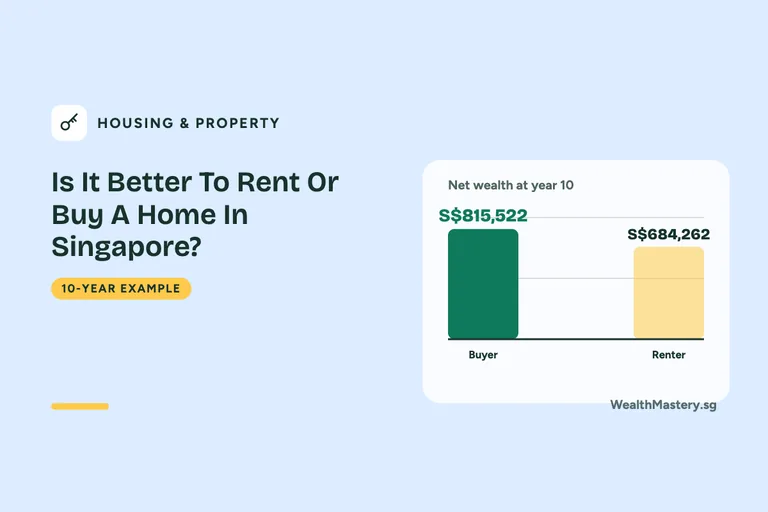
The buyer pays S$337,600 upfront, including BSD, and S$4,268 a month. At year ten, the buyer’s modelled net wealth is S$815,522 against the renter’s S$684,262. Buying first catches up at the end of year five: a point in the model, not a promised sale date.
- Buyer Pays Upfront, With BSD: S$337,600
- Renter Invests That Sum: S$337,600
- Each Month, The Cheaper Side Invests The Difference
- Buyer’s Net Wealth, Year Ten: S$815,522
- Renter’s Portfolio, Year Ten: S$684,262
- Buying Ahead By: S$131,260
Data as of and . Source: MoneySense — Upfront And Ongoing Property Costs; IRAS — stamp-duty rates.
Try Your Numbers
Compare Your Own Rent And Home Price
Uses the example’s 25% downpayment, 25-year loan at 3%, S$400 owner costs, 2% rent growth, 5% investment return and a Singapore Citizen’s first home.
Buyer’s Net Wealth At The End
S$815,522
- Renter’s Portfolio At The End
- S$684,262
- Monthly Mortgage Instalment
- S$4,268/mth
Rough estimate. See the full tool for assumptions.
What Does The Comparison Leave Out?
This example is a Singapore Citizen’s first home, so there is no ABSD. The tool adds any ABSD for your residency and the homes you own. On a S$1.4 million condo, a PR’s 5% ABSD adds S$70,000 and can flip the answer. Selling within 4 years also costs SSD (Seller’s Stamp Duty). Buyer net wealth subtracts the remaining loan and the selling costs you enter. It is not the full property value or cash in the bank.
The tool leaves out taxes other than BSD, CPF effects, renovation, grants, rent deposits and investment fees. Owner costs stay flat, and smooth growth cannot show a property crash or market swings.
Which Assumptions Could Change Your Choice?
Try a shorter stay, zero price growth, higher mortgage costs and lower returns, one at a time. Zero growth is a stress test, not the worst possible loss.
Then weigh stability, flexibility, commute and family plans. Check borrowing separately with the borrowing calculator, and get financing advice before committing.
Quick Check
Three statements from this guide. Tap True or False to check what you have read. Nothing is saved.
Card 1 Of 3
Comparing your rent with the mortgage instalment shows which option leaves you better off.
Why?
Buying also locks up a downpayment and buying costs a renter could invest. So the tool compares net wealth on both sides over the same period.
Card 2 Of 3
The model assumes the renter invests the money the buyer pays upfront.
Why?
In the example the renter starts by investing S$337,600. The result only holds if those savings really are invested, not spent.
Card 3 Of 3
The buyer’s net wealth is the full value of the home.
Why?
It is not the full property value or cash in the bank. Selling within 4 years also costs Seller’s Stamp Duty.
Your Score
Try It With Your Numbers
Open the calculator with this guide’s example filled in. Then change the numbers to match your situation.
Open Rent Vs Buy Calculator →Frequently Asked Questions
Why Can’t I Just Compare Rent With A Mortgage Instalment?
Part of a mortgage instalment pays off the loan itself, so it is not like for like with rent.
Buying also locks up a downpayment and buying costs that a renter could invest. So the calculator tracks net wealth for both options over the same period.
Try Rent Vs Buy Calculator →How Long Does Buying Take To Catch Up With Renting?
In the guide’s S$1.2 million example, buying first catches up at the end of year five.
That is a point in the model under those assumptions. It is not a promised sale date or a guarantee that buying stays ahead under other assumptions.
What Does The Rent Vs Buy Comparison Leave Out?
It adds BSD and any ABSD for the residency and Singapore homes you pick, and SSD if you sell within 4 years.
It does not check whether you can borrow. It leaves out taxes other than BSD, CPF effects, renovation, grants, rent deposits and investment fees. Owner costs stay flat, and smooth growth cannot show a property crash or market swings.
Which Assumptions Should I Test?
Try a shorter stay, zero price growth, higher mortgage costs and lower investment returns.
Change one input at a time to see which drives the result. Then weigh non-money needs such as stability, flexibility, commute and family plans.
Get The Checklist (Free For Members)
Buying A Resale Or Private Home: Loan, Cash And Stamp Duty. Check your loan, cash, CPF and stamp duty before you buy a resale flat or private home.
Get The ChecklistFree account. No password needed.
Save Guides Free
Keep This Guide For Your Next Money Decision.
Build your own reading list and pick up where you left off with a free WealthMastery account.
Free account · Tools stay free without an account.
Sources & Assumptions
Sources checked 12 October 2026. These are examples only. Check the stated assumptions and limits before you use a result.
A what-if comparison, not a forecast or advice to rent or buy. Returns and costs are your own inputs. It leaves out borrowing eligibility and several real-world costs.