Quick Answer
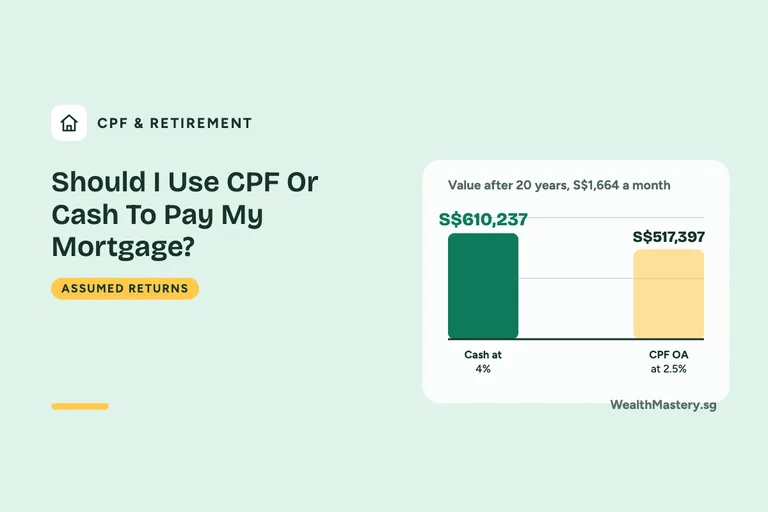
It depends on what the cash you keep would really earn. Take a S$300,000, 20-year loan at 3%. The money you keep grows to S$610,237 at 4%, versus S$517,397 at the 2.5% OA rate. That is a S$92,840 modelled difference. It favours using CPF only if you keep and invest the cash.
The Useful Number: Take a S$300,000, 20-year loan at 3%. Keeping cash that earns 4% leaves S$92,840 more than the 2.5% OA rate. That only holds if you really keep and invest the cash.
What Happens To The Money You Do Not Spend?
Pay instalments with cash and your CPF stays untouched; pay with CPF and your cash is free. The calculator grows the same monthly amount both ways: at 2.5% in OA, and at the cash return you enter.
It shows what you give up over the loan term, not your full wealth, and does not check that your OA covers every instalment.
How Does A S$300,000 Loan Over 20 Years Compare?
Take a S$300,000 loan over 20 years at 3%, or S$1,664 a month, with cash earning 4%. The money you keep grows to S$610,237 at 4%, against S$517,397 at the 2.5% OA rate: S$92,840 in favour of paying with CPF. Rough accrued interest on the CPF used is S$118,087.
If the cash return is low enough, the result flips. If you spend the cash, the comparison no longer holds.
- Monthly Instalment: S$1,664
- Pay With Cash: OA Grows At 2.5%: S$517,397
- Pay With CPF: Cash Grows At 4%: S$610,237
- Modelled Difference, In Favour Of CPF: S$92,840
Data as of . Source: CPF Board — earning CPF interest.
Try Your Numbers
Compare Paying With CPF Or Cash
One fixed rate for the whole loan. OA grows at 2.5%. It only holds if you really keep and invest the cash.
Pay With CPF: Your Cash Grows To
S$610,237
- Pay With Cash: Your OA Grows To
- S$517,397
- Monthly Instalment
- S$1,664/mth
Rough estimate. See the full tool for assumptions.
Does A CPF Refund Go Back To Your CPF?
When you sell, CPF rules usually require you to refund the CPF you used, plus accrued interest, from the sale proceeds. That leaves less cash from the sale, but the money goes back to your CPF. It is not extra interest paid to the bank, so do not count it as a loss.
The refund estimate uses a simple stream of instalments and leaves out CPF downpayments, extra-interest tiers and past refunds. For a real sale, use the housing refund amount in your CPF dashboard.
How Do Access To Cash And Risk Change The Answer?
Cash returns are not certain and can carry fees. Using CPF reduces your retirement savings and has usage limits. Test lower cash returns, and check your CPF, emergency savings and sale plans before you choose.
Quick Check
Three statements from this guide. Tap True or False to check what you have read. Nothing is saved.
Card 1 Of 3
The CPF you refund when you sell is extra interest paid to the bank.
Why?
When you sell, you usually refund the CPF used plus accrued interest from the sale proceeds. That means less cash from the sale, but it is not a loss of wealth.
Card 2 Of 3
In the example, paying with CPF comes out about S$92,840 ahead.
Why?
That only holds if you really keep and invest the cash. If the cash return is low enough, the result flips.
Card 3 Of 3
If you spend the cash you kept, the CPF result still holds.
Why?
Cash returns are not certain either. Test lower cash returns, and check your emergency savings and sale plans before you choose.
Your Score
Try It With Your Numbers
Open the calculator with this guide’s example filled in. Then change the numbers to match your situation.
Open CPF Vs Cash Mortgage Payoff →Frequently Asked Questions
Is The CPF Refund On Sale Extra Interest Paid To The Bank?
No.
When you sell, CPF rules usually require you to refund the CPF you used, plus accrued interest, from the sale proceeds. This means less cash from the sale, but the money goes back to your CPF. It is not extra interest paid to the bank, so do not count it again as a loss.
When Does Paying With Cash Come Out Ahead?
The result flips when your cash return is low enough compared with the 2.5% OA rate.
It also fails if you spend the cash instead of investing it. The model favours CPF only if that cash is kept and invested.
What Does The Mortgage Comparison Leave Out?
It compares equal payments at fixed rates over the loan term.
It does not model investment risk, fees, CPF usage eligibility, refinancing, your age or your full household finances. It also does not promise you have enough OA for every instalment.
How Accurate Is The Accrued-Interest Figure?
The refund estimate, about S$118,087 in the example, uses a simple stream of instalments.
It leaves out CPF downpayments, extra-interest tiers, real withdrawal dates and past refunds. For a real sale, use the exact housing refund amount in your CPF dashboard.
Get The Checklist (Free For Members)
Buying A Resale Or Private Home: Loan, Cash And Stamp Duty. Check your loan, cash, CPF and stamp duty before you buy a resale flat or private home.
Get The ChecklistFree account. No password needed.
Save Guides Free
Keep This Guide For Your Next Money Decision.
Build your own reading list and pick up where you left off with a free WealthMastery account.
Free account · Tools stay free without an account.
Sources & Assumptions
Sources checked 12 October 2026. These are examples only. Check the stated assumptions and limits before you use a result.
Rough comparison of equal payments at fixed rates. It does not model investment risk, fees, CPF usage eligibility, refinancing or your full household finances.