Plan Your Monthly Savings Split →
Quick Answer
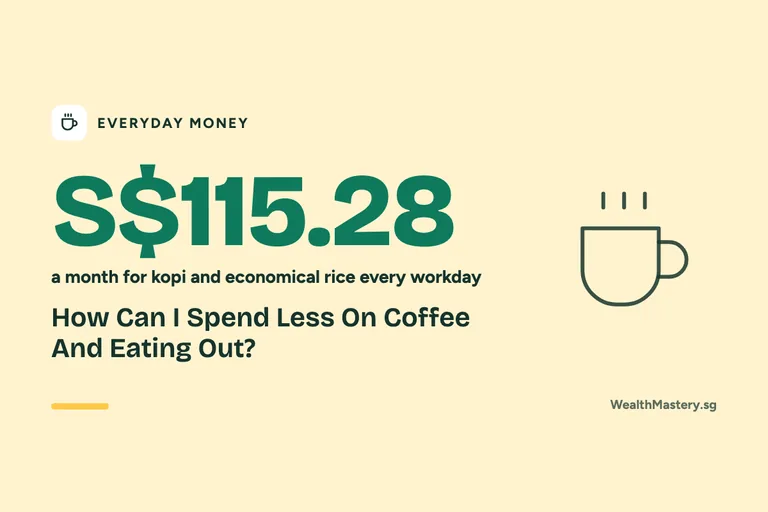
Price your daily habits. At August 2026 average prices, a kopi and a plate of economical rice every workday cost S$115.28 a month. Swapping a S$7.93 chicken chop for economical rice saves S$90.86 a month. Bring your own cup, redeem café loyalty points before they expire and spend expiring CDC Vouchers first.
The Useful Number: At August 2026 average prices, a kopi and a plate of economical rice every workday cost S$115.28 a month. Swap a S$7.93 chicken chop for economical rice and you keep S$90.86 a month.
Why Do Small Food Bills Matter?
Coffee and lunch are the money you spend without thinking, five days a week. That makes them one of the easiest places to save, because one change repeats itself about 22 times a month.
You do not need to give up treats. Know what each habit costs a month, keep the ones you value and trim the rest. Every dollar you save on a daily habit is about S$22 a month, or S$264 a year.
No brand paid to appear in this guide.
Kopi Or Café Coffee: What Is The Difference?
The Department of Statistics tracks average prices of everyday food. In August 2026 a cup of coffee or tea with condensed milk averaged S$1.44, and without milk S$1.27. A kopi every workday comes to S$31.68 a month.
There is no official average for a café latte, so use your own receipt. Take the difference between your usual café cup and a kopi, then multiply by 22. If the gap is S$4, that is S$88 a month. Many people keep café coffee for weekends and drink kopi or office coffee on workdays.
What Does A Month Of Workday Lunches Cost?
Take the same August 2026 averages. Economical rice with one meat and two vegetables was S$3.80 a plate, chicken rice S$4.23 and a chicken chop S$7.93.
Economical rice and a kopi on all 22 workdays cost S$83.60 plus S$31.68, or S$115.28 a month. A daily chicken chop costs S$174.46, so swapping it for economical rice saves S$90.86 a month. Bringing lunch from home on some days saves more, if you count what the ingredients cost.
These are averages across outlets. Your prices will differ, so track one normal week and multiply by four to find your real number.
- Economical Rice: S$83.60
- Kopi: S$31.68
- Lunch And Kopi For A Month: S$115.28
- Daily Chicken Chop: S$174.46
Data as of . Source: SingStat — Average Retail Prices Of Selected Consumer Items, August 2026 Averages.
Where Can You Find Budget Meals?
Since 10 January 2026, HDB coffee shop operators can choose to join a budget meals scheme. Those that do must offer an economy rice meal, a halal meal, a breakfast item and two budget drinks, in return for a rent discount or a lower outdoor seating fee. Look for the budget meal signs at your nearest coffee shop.
NEA does not require hawker stalls to sell budget meals, but at socially-conscious enterprise hawker centres, each stall must offer at least one value meal.
CDC Vouchers help too. The January 2026 tranche gave each Singaporean household S$150 for heartland merchants and hawkers, valid until 31 December 2026, so spend it first. The June 2026 tranche gave S$250 for heartland merchants and hawkers, valid until 31 December 2027.
How Do You Make Café Loyalty Points Pay?
Take Starbucks Rewards as an example. Members earn 1 Star per S$1 when paying with a registered Starbucks Card, and 1 Star per S$2 with cash or a debit or credit card. Topping up the card earns no Stars. A free Tall or Grande handcrafted drink costs 60 Stars, so it takes S$60 of spending on the Starbucks Card, or S$120 paid any other way.
Stars expire 12 months after you reach a level, so redeem them rather than save them. Earn 300 Stars in 12 months and you reach Gold, which adds bigger rewards. Members get a slice of cake with a drink bought in their birthday month, and Gold members also get a free drink.
Bring your own mug or tumbler for 50 cents off each drink: S$11 a month over 22 workdays.
Should You Pay With A Dining Cashback Card?
A credit card that pays cashback or miles on dining can return part of what you already spend, but only if you pay the bill in full each month. Check which outlets count as dining, the minimum monthly spend and the cap. Paying with a Starbucks Card earns more Stars, but you may lose your credit card reward on that spend, so compare the two.
See which cards pay the most on dining in our credit card comparison.
HPB’s Eat, Drink, Shop Healthy Challenge runs until 31 December 2026. Buy a qualifying item, such as kopi O kosong, at a supporting outlet and scan its QR code in the Healthy 365 app to earn Healthpoints.
What Should You Change This Week?
- Write down every coffee and lunch for one normal week.
- Multiply by four to see your monthly number.
- Pick one habit to swap on workdays, and keep one treat.
- Bring your own cup to cafés.
- Redeem Starbucks Stars before they expire.
- Spend CDC Vouchers that end on 31 December 2026 first.
- Use a dining card only if you clear the bill in full.
- Move the money you save into savings on payday.
Quick Check
Three statements from this guide. Tap True or False to check what you have read. Nothing is saved.
Card 1 Of 3
A kopi and economical rice every workday cost about S$115 a month at August 2026 average prices.
Why?
The averages are S$3.80 a plate and S$1.44 a cup. Your own prices will differ, so track a normal week.
Card 2 Of 3
Paying with cash or a credit card earns Starbucks Stars as fast as a registered Starbucks Card.
Why?
A free drink costs 60 Stars, so that is S$60 of spending on the Starbucks Card or S$120 paid any other way.
Card 3 Of 3
Every hawker stall must sell a budget meal.
Why?
Stalls at socially-conscious enterprise hawker centres must offer at least one value meal, and HDB coffee shops can choose to join a budget meals scheme.
Your Score
Give Your Food Budget A Home
Decide how much of your take-home pay goes to needs, wants and savings, then see where a cheaper lunch habit can take you.
Plan Your Monthly Savings Split → Compare Dining Cashback Cards →Frequently Asked Questions
How Many Starbucks Stars Do I Need For A Free Drink?
60 Stars buy a free Tall or Grande handcrafted drink.
Members earn 1 Star per S$1 with a registered Starbucks Card and 1 Star per S$2 with cash or a card, so that is S$60 or S$120 of spending.
Do Starbucks Stars Expire?
Yes.
Stars are valid for 12 months from the date you reach a level, then the balance returns to zero. Redeem them for a drink or a discount rather than letting them pile up.
Is There A Discount For Bringing My Own Cup To Starbucks?
Yes.
Starbucks Singapore gives 50 cents off each drink when you bring your own mug or tumbler. Over 22 workdays, that is S$11 a month.
When Do My CDC Vouchers Expire?
The January 2026 CDC Vouchers are valid until 31 December 2026, and the June 2026 tranche until 31 December 2027.
Spend the older vouchers first at participating hawkers and heartland merchants.
Do HDB Coffee Shops Have To Sell Budget Meals?
Not since 10 January 2026.
Operators can choose to join the budget meals scheme for a rent discount, and those that join must offer an economy rice meal, a halal meal, a breakfast item and two budget drinks.
Save Guides Free
Keep This Guide For Your Next Money Decision.
Build your own reading list and pick up where you left off with a free WealthMastery account.
Free account · Tools stay free without an account.
Sources & Assumptions
- SingStat — Average Retail Prices Of Selected Consumer Items, Monthly ↗
- HDB — Enhanced Support For HDB Coffee Shops To Provide Affordable Cooked Food Options ↗
- MSE — Reply On Budget Meal Options At Hawker Centres ↗
- CDC Vouchers — About CDC Vouchers Scheme 2026 (June) ↗
- CDC Vouchers — Residents’ FAQ ↗
- Starbucks Singapore — Starbucks Rewards Member Benefits ↗
- Starbucks Singapore — Starbucks Rewards Terms Of Use ↗
- Starbucks Singapore — Go Green With Starbucks ↗
- HealthHub — Eat, Drink, Shop Healthy Challenge ↗
Sources checked 13 October 2026. These are examples only. Check the stated assumptions and limits before you use a result.
Prices are SingStat averages for August 2026 across outlets, not quotes for any stall. Starbucks, CDC Voucher, HDB and HPB rules checked on 13 October 2026, and they may change. The monthly figures are approximate and assume 22 workdays. Card rewards depend on each card’s terms.