Quick Answer
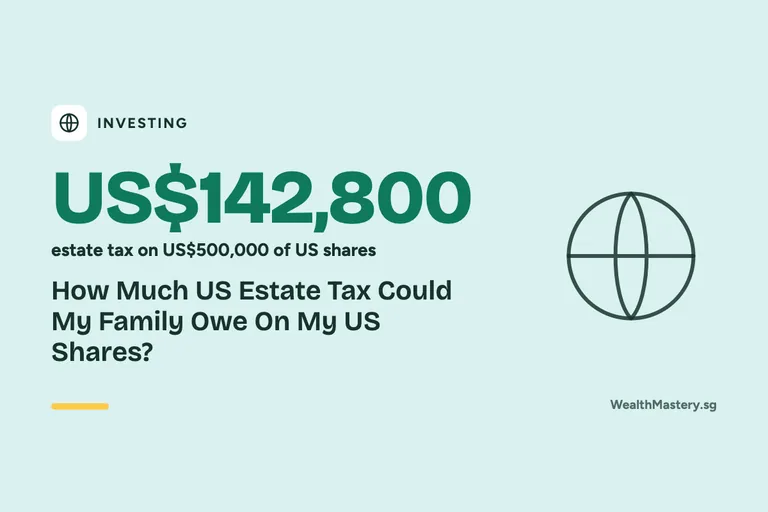
Non-US persons get only about US$60,000 of US assets free of US estate tax, and Singapore has no estate tax treaty with the US. Above that, federal rates climb from 18% to 40%. US$500,000 of US shares could mean a bill of about US$142,800, roughly 29% of the holdings.
The Useful Number: US$500,000 of US shares could mean a US estate tax bill of about US$142,800, roughly 29% of the holdings, because the exemption for non-US persons is only US$60,000.
Why Can US Shares Create An Estate Tax Bill?
The US taxes the US assets of people who are not US citizens or residents when they die. For them, only about the first US$60,000 is covered: a US$13,000 credit cancels the tax on that amount. Above it, the federal rates climb from 18% to 40%.
Shares of US companies count as US assets (US-situs), and so do US-domiciled ETFs, even if you bought them through a Singapore broker. Singapore has no estate tax treaty with the US to lower the bill.
What Could US$500,000 Of US Shares Cost Your Family?
- US-situs assets: US$500,000
- Tax from the rate schedule: US$155,800
- Credit for non-US persons: −US$13,000
- Rough estate tax: US$142,800
- Share of the holdings: About 29%
At US$100,000 the rough bill is US$10,800, and at US$1 million it is about US$332,800. Each extra dollar above US$1 million is taxed at 40%. Your family may also need to file a US return (Form 706-NA) before US brokers release the assets.
- US-Situs Assets: US$500,000
- Tax From The Rate Schedule: US$155,800
- Minus The Credit For Non-US Persons: US$13,000
- Rough Estate Tax: US$142,800
Data as of . Source: IRS — Instructions for Form 706-NA.
What Does The Estimate Leave Out?
It is approximate. It ignores deductions for debts and expenses, how the IRS values assets, gifts made before death, US property and cash, and state taxes. Some deductions need your worldwide estate to be disclosed. It is not tax or estate advice.
Shares of non-US companies are not US-situs, so Ireland-domiciled funds that hold US shares are outside US estate tax. Singapore-listed shares are not US-situs either.
What Can You Check Next?
Add up the US-listed shares and US-domiciled ETFs you hold and run the calculator. Compare domiciles with the ETF dividend tax guide, and make sure your will and nominations are in order with the legacy checklist guide. For a real plan, speak to a qualified tax or estate adviser.
Quick Check
Three statements from this guide. Tap True or False to check what you have read. Nothing is saved.
Card 1 Of 3
A non-US person gets about the first US$60,000 of US assets free of US estate tax.
Why?
Above it, federal rates climb from 18% to 40%.
Card 2 Of 3
Ireland-domiciled funds that hold US shares count as US assets for US estate tax.
Why?
US-domiciled ETFs and shares of US companies are US-situs, even when bought through a Singapore broker.
Card 3 Of 3
US$500,000 of US shares could mean a rough bill of about US$142,800.
Why?
That is roughly 29% of the holdings, and each extra dollar above US$1 million is taxed at 40%.
Your Score
Try It With Your Numbers
Open the calculator with this guide’s example filled in. Then change the numbers to match your situation.
Open US Estate Tax Estimator →Frequently Asked Questions
Do Ireland-Domiciled ETFs Count For US Estate Tax?
No.
The IRS treats shares of US companies, including US-domiciled ETFs, as US assets. Shares of non-US companies, such as Ireland-domiciled funds, are not US-situs, so they fall outside US estate tax.
How Much Is Exempt For A Singapore Investor?
About the first US$60,000 of US-situs assets.
A US$13,000 credit cancels the tax on that amount, and anything above is taxed from the rate schedule.
Is This Estimate Exact?
No.
It ignores deductions for debts and expenses, gifts made before death, valuation rules and state taxes. For a real plan, speak to a qualified tax or estate adviser.
Get The Checklist (Free For Members)
Holding US Shares And ETFs: Tax And Estate Checklist. What to check on US dividend tax and US estate tax when you hold US shares or funds from Singapore.
Get The ChecklistFree account. No password needed.
Save Guides Free
Keep This Guide For Your Next Money Decision.
Build your own reading list and pick up where you left off with a free WealthMastery account.
Free account · Tools stay free without an account.
Sources & Assumptions
Sources checked 12 October 2026. These are examples only. Check the stated assumptions and limits before you use a result.
Approximate, general information only, not tax or legal advice. Uses the US federal rate schedule and the US$13,000 credit for non-US persons, checked 12 October 2026. Ignores deductions, gifts, valuation rules and state taxes.